
Is Your “Fixed” Electricity Price Really Fixed?
From the Desk of Stephanie Grenier, VP of Operations Bringing 30+ years of experience in energy, business development, and operational strategy
As I spend my weekend planting mums and blowing leaves, I find myself reminiscing about all the great times we had this past summer. Like many across the U.S., we celebrated our country’s 250th anniversary on July 4th in Massachusetts — or, as my husband likes to say, “Where America was invented.” We spent the holiday with friends and family, enjoying good food, playing games in the yard, and watching fireworks late into the evening.
For those across the Midwest, Mid-Atlantic, and New England who spent the holiday outdoors, you probably recall just how hot and humid it was that weekend. Temperatures soared above 100 degrees in many areas, causing air conditioners to run at full capacity to beat the heat.
NOAA’s July temperature map below illustrates just how widespread the heat was, with above-normal temperatures across much of the country. By historical standards, 2026 is shaping up to be one of the hottest summers on record.
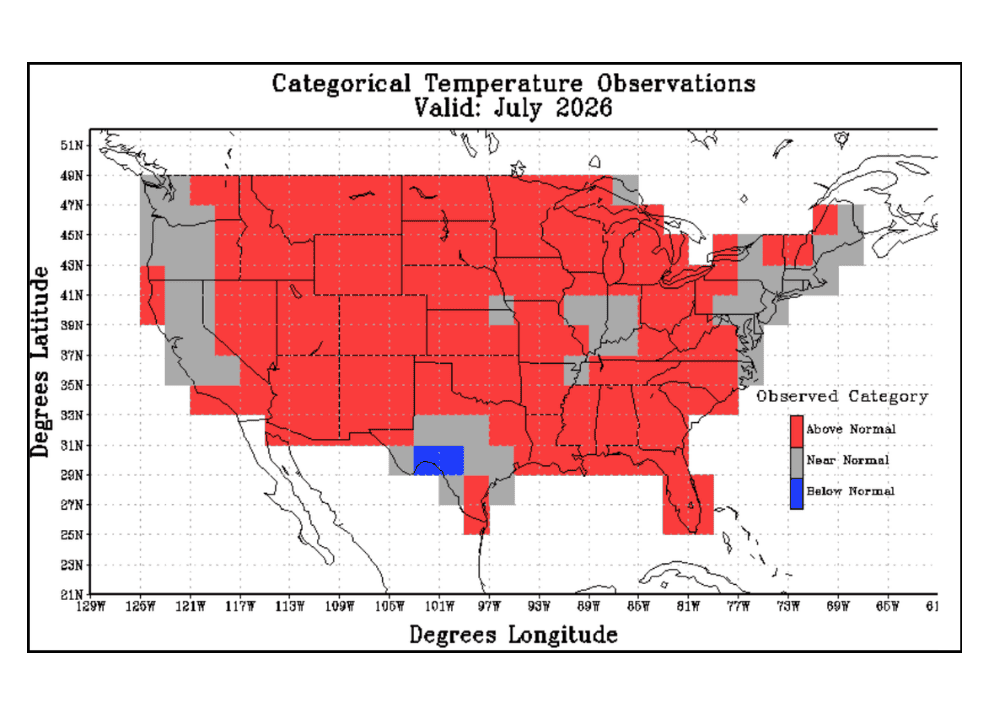
Great weather for swimming and boating… Not so great for electricity costs.
When Heat Drives Electricity Demand
As temperatures rise, electricity demand increases as air-conditioners run around the clock. During the hottest periods, the grid can become increasingly constrained as homes and businesses are all using electricity at the same time. Businesses respond to these conditions in different ways.
Many manufacturers and large energy users temporarily reduce their electricity consumption. Others shut down their operations early or adjust production schedules to avoid higher energy prices and help stabilize the grid. Businesses that are unable to reduce their usage, such as retailers and critical care providers, may be forced to absorb the higher costs.
Even those with a third-party electricity supply contract aren’t necessarily insulated from these costs. A contract may have a fixed energy price, but that doesn’t always mean every component of the customer’s electricity rate is “fixed”.
How do Capacity Costs Impact Electricity Prices?
For businesses with interval meters (meters that record electricity usage in short intervals, typically 15-minutes) there is an opportunity to lower certain demand-based costs by reducing electricity usage during PJM’s Critical Peak (CP) hours.
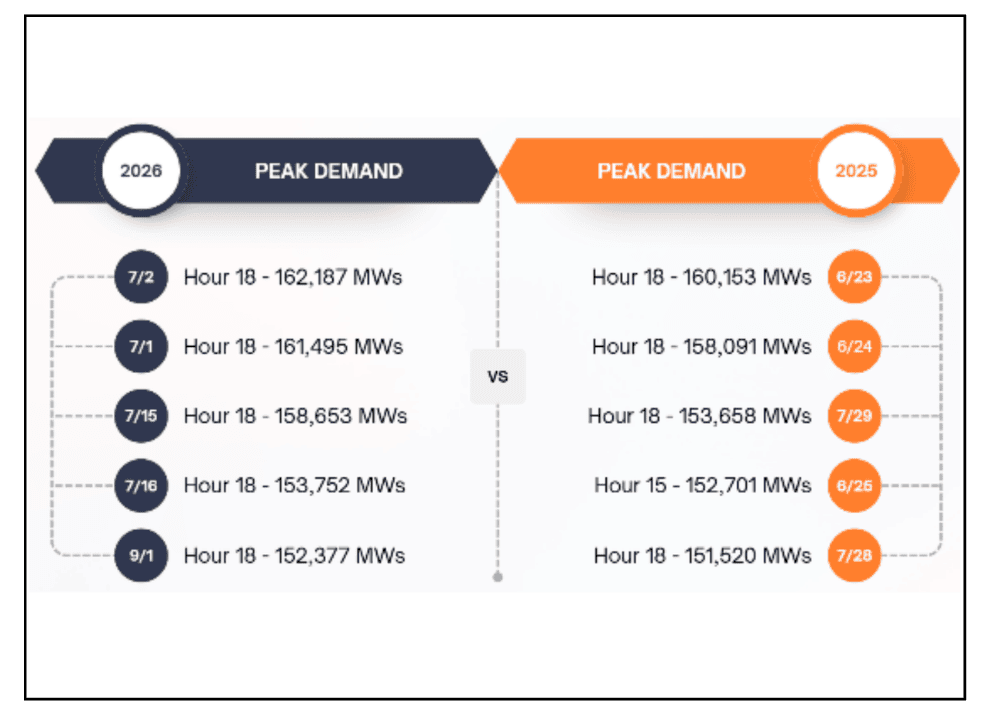
PJM Regional Transmission Operator , which manages the electric grid across 13 states and the District of Columbia, monitors and tracks electricity demand throughout the year. During the summer months of June through September, PJM identifies the five highest-demand hours across the system. These hours typically occur during the late afternoon when temperatures are high and air-conditioning demand is still elevated. For end-users with interval meters, usage during those 5 CP hours is used to determine the capacity obligation for the following planning year. In simple terms, higher usage during those peak hours can mean higher capacity costs in the future.
The graph below shows actual electricity demand across PJM and compares when the CP hours occurred during the past two summers. Compared with 2025, the first two days of July 2026 saw significantly higher demand than last year’s highest peak, putting them among the highest-demand periods on record.
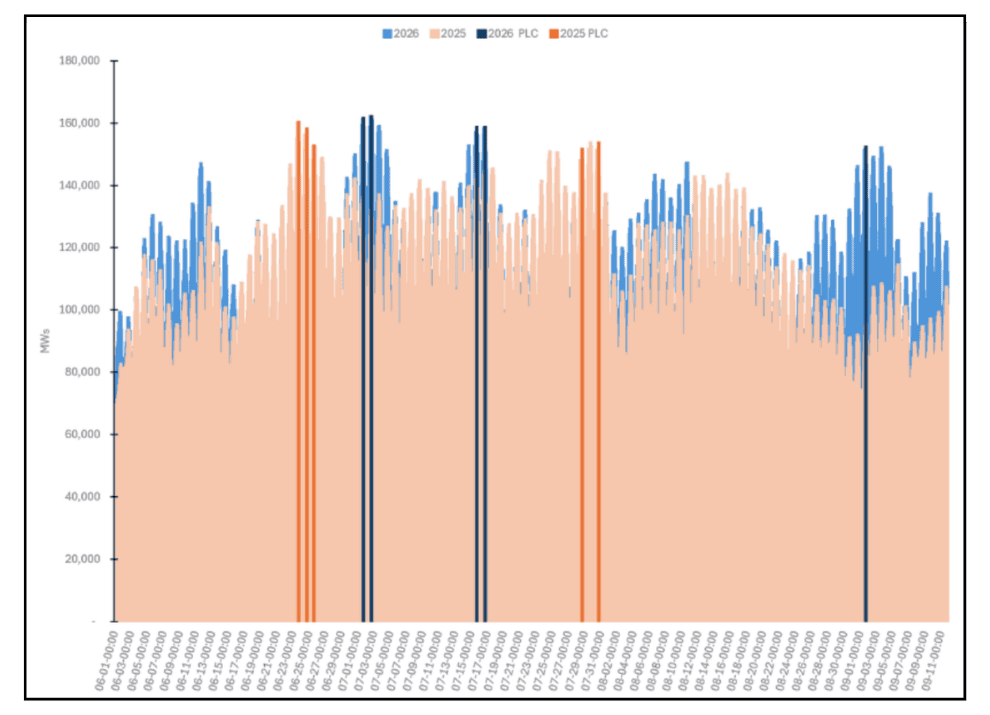
Many electricity suppliers and demand response providers offer email notifications when PJM is approaching a potential peak. These alerts are voluntary, allowing businesses to decide whether they can temporarily reduce their electricity consumption during those hours.
For businesses that are able to respond, reducing usage during these peak periods can help lower future capacity costs. For a manufacturer, that could mean shifting production. For another business, it might mean temporarily reducing HVAC usage or turning off nonessential equipment.
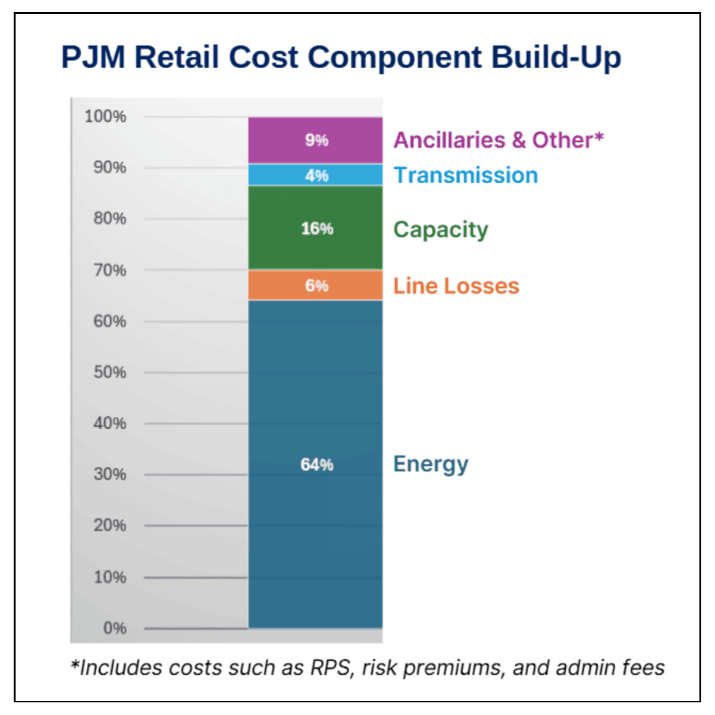
Capacity is essentially the cost of ensuring that enough electricity supply is available to meet demand when the grid needs it most. Before June 2025, capacity typically represented approximately 4–6% of the total electricity price for many businesses. Today, that percentage can be closer to 10–20%, depending on the end-user and market. The chart below provides a simplified look at the different components that make up a customer’s total electricity cost in PJM, whether the electricity is purchased from the utility or through a third-party supplier.
It’s Not Just Capacity
Capacity gets much of the attention, but it isn’t the only component creating more uncertainty. Energy prices and ancillary service costs have become more volatile, driven in part by changes implemented by PJM in October 2025 through its Regulation Market Design.
The first phase of the redesign is intended to improve grid reliability and better account for the changing mix of resources being used to supply electricity across the PJM region. While these changes serve an important purpose, they also changed how certain ancillary costs are calculated. As a result, some suppliers are now passing those additional costs on to customers through price adjustments.
How Can a “Fixed” Electricity Price Change?
The answer is in the contract. Electricity supply agreements include provisions that allow the supplier to recover and pass through unforeseen or incremental costs. This typically includes a change in law or fundamental change to an existing cost structure, such as the recent change that has impacted ancillaries. Other provisions will call out specific components, such as capacity, that can be adjusted due to a change in the customers’ CP demand (also called a PLC or Capacity Tag) that was not factored in the original price. Depending on the product structure and impact, this could result in either a charge or a credit.
Subject to the language of the agreement, these costs may be incorporated into a new total rate or appear as a separate line item on the customer’s bill. In other words, “fixed” doesn’t always mean that nothing can change.
Three Ways Businesses Can Prepare
With electricity markets becoming more complicated and volatile, businesses should not assume that the price quoted will be the same by the end of a contract. Here are a few ways businesses can prepare and avoid surprises.
- Understand the product structure. Ask them to identify the contract provisions addressing change in law, material change, capacity, transmission, and any other potential pass-through costs. Ask if certain components are bilaterally passed through (credit or charge) or just applied if the supplier incurs an increase in costs. Don’t assume that a fixed price means every cost is fixed.
- Know what’s included in your price. If it isn’t clearly outlined in the agreement, request a breakdown of the components included in the quoted price. More importantly, confirm whether the supplier is using the most recent usage and demand data when calculating these costs. A price based on outdated information can result in adjustments, potentially on the first invoice.
- Choose a term that fits your business. Longer-term fixed contracts can provide budget certainty and protection against future energy price increases but offer less flexibility if your business changes. The longer the term, the more opportunities there are for certain components to change, potentially resulting in price adjustments. There is also a risk of early termination penalties, if your lease ends or you sell the business before the contract ends.
The Bottom Line
With electricity markets becoming more complicated and volatile, businesses should not assume that every component of the price will remain unchanged for the entire contract term. A “fixed” electricity price can still contain variable components. Understanding what is — and isn’t — included in your electricity contract is one of the simplest ways to avoid unexpected costs.
At Green Climate Energy Consulting, we help businesses put these three recommendations into practice. We take a case-by-case approach to reviewing your energy contract, understanding what is and isn’t included in your price, and evaluating which product and term best fit your business. Whether your priority is budget certainty, reducing energy costs, or maintaining flexibility as your business changes, our energy expertise can help you make informed decisions and navigate the complexities of today’s changing energy market.